This site will be updated regularly, please come back as we continue to add more information!
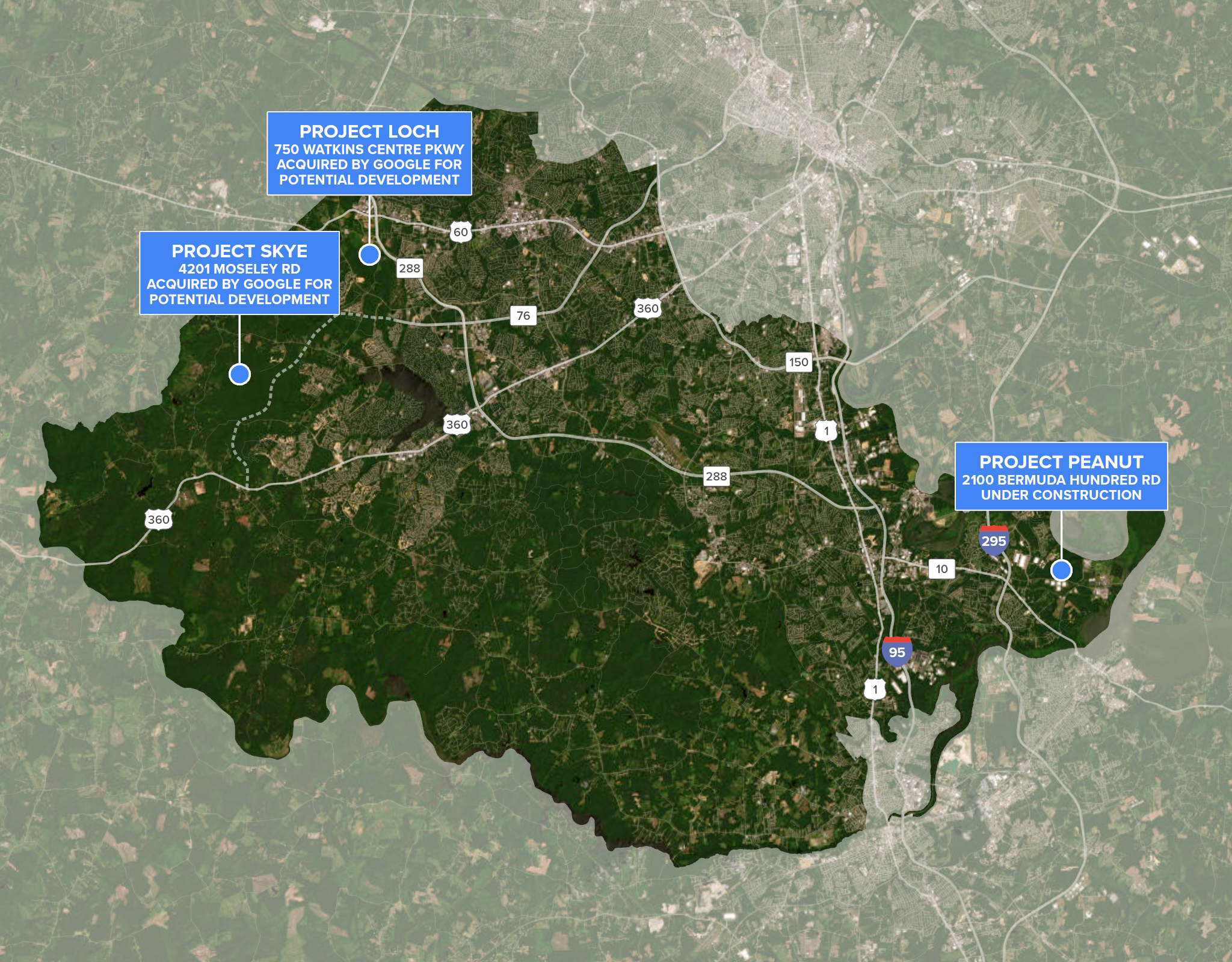
Google is expanding its digital infrastructure with plans for three data center campuses in Chesterfield County, Virginia. These facilities will help power the modern internet—supporting everything from healthcare systems and schools to the everyday online tools we all rely on. As planning moves forward, we are committed to collaborating closely with local leaders, residents, and stakeholders to ensure these projects are developed thoughtfully and responsibly.
Our approach
At Google, we focus on responsible development.
Our projects are not "cookie-cutter" facilities; we evaluate each site individually to optimize for business needs, the environment, and the local community. These sites represent a significant economic investment in Chesterfield County, creating thousands of construction jobs, hundreds of full-time operational roles, and improvements to local infrastructure. Beyond the facilities themselves, Google plans to partner with local organizations to expand access to skilled trades training, technology education, and no-cost Google Career Certificate programs, while also supporting other critical needs and local priorities.
With this development comes a deep commitment to being a good neighbor. We understand that projects of this scale naturally bring questions about how data centers operate and what they mean for the surrounding neighborhood. To provide clarity, we have compiled clear, fact-based information here about the proposed sites, our track record of responsible environmental stewardship, and the potential local impacts.
We invite you to explore the project details below, learn more about our plans, and engage with us throughout the planning process.
Data centers are the backbone of the internet—often described as high-tech “warehouses” that store and process the vast amounts of data powering our digital world. Instead of housing physical goods, they contain thousands of servers that support nearly everything we do online.
They play a critical role in everyday life. Essential services like healthcare systems, emergency response, banking, and government operations all rely on data centers to securely store and transmit information. Google selects data center sites based on three factors:
Focuses on power capacity, transmission infrastructure, and 24/7 carbon free power.
Evaluates network and water access, land permitting, natural disaster risks, and workforce availability.
Considers business demand and a constructive business environment.
Please see datacenters.google for additional information on Google data centers.
Energy & affordability
Google pays for 100% of the electricity used to power its data centers and invests in new energy sources that benefit all energy users and keep rates affordable. Google's energy infrastructure investments benefit the wider energy grid and make it more resilient during weather events. We work with utilities, governments, and communities to bring new energy sources online more quickly and find ways to optimize our existing electrical grid. Over the past five years, our data centers have delivered more than 6x more computing power for the same amount of electricity. And we work with utilities to reduce our power demand during times of peak grid stress, including participating in demand response programs. As the #1 buyers of clean energy, tech companies play a pivotal role in making projects financially viable and driving innovation in emerging clean technologies.
Virginia residents will not pay for Google's infrastructure, as Google has pledged to fully cover its own electricity costs and infrastructure needs. Data centers can help put downward pressure on utility rates by spreading fixed costs across more energy usage, helping reduce costs for all customers. An average 0.6 cent per kWh reduction in energy prices was associated with a 10% increase in energy load. Additionally, Google recently announced a new $15 million Energy Impact Fund to help drive down monthly utility bills for households across the state. As the largest data center market in the world, Virginia faces unique challenges and opportunities related to this rapidly expanding sector. In late 2024, the Virginia General Assembly's Joint Legislative Audit and Review Commission (JLARC) published a report that included an in-depth analysis of how data center growth affects Virginia's electric grid, energy policy, and ratepayers. The Virginia JLARC Study indicated that data centers are currently paying their full cost of service for energy.
Other states show similar positive impacts on utility rates. In Georgia, Georgia Power confirmed that large energy users, like data centers, are helping them keep rates frozen for the next 3 years, which directly benefits other customers. In Pennsylvania, the Pennsylvania Public Utility Commission highlighted that concentrated electricity use by data centers creates efficiencies by requiring minimal grid infrastructure. This helps lower transmission costs and reduce rates for all customers, with PPL Electric estimating a 10% reduction from the first gigawatt of interconnected load.
Water stewardship
Google ensures water resource protection through a comprehensive stewardship framework focused on transparency, climate-conscious cooling, and responsible water use. The company reports annual water usage for each data center location in its Environmental Report, to maintain community trust and uses a science-based framework to assess watershed health, prioritizing alternatives like air-cooling or recycled water in high-risk areas.
A key pillar of Google's strategy is replenishment, with an ambitious goal to replenish 120% more freshwater than it consumes across its data centers and offices by 2030. This initiative actively supports the improvement of water quality and the restoration of ecosystem health in the local communities where Google operates.
In regions like Virginia, Google invests in active and completed stewardship projects to support local watersheds. These efforts include funding forested riparian buffers to filter agricultural nutrients, implementing technology-driven stormwater management retrofits, and partnering on ecological projects like a freshwater mussel nursery to naturally enhance water quality.
See links below for more information:
Local investment
To meet the technical demands of the AI economy, deep, immediate investments are required to modernize skilled trade training curricula and expand the AI-ready workforce at the national and local level. To help, Google is providing labor unions, contractor associations, and workforce training providers $50M in funding to rapidly accelerate training, modernize curricula, and focus on the key trades essential for the nation's technological future.
As a result of Google's funding, the electrical training ALLIANCE and local electrical apprenticeship training partners will be able to increase training capacity to support an additional 2,741 apprentices by 2030, increasing the projected pipeline of new electricians in Virginia by 137%.
As we advance development in the County, we are committed to supporting nonprofits and other organizations that support the vitality of Chesterfield. To date, we have supported several initiatives, including:
Project Peanut is located in Chester near the Meadowville Technology Park on Bermuda Hundred Road
Site Details
Construction
Project Peanut is currently under construction, with the first of three planned buildings scheduled for completion in late 2027. Full campus completion is expected in 2028.
Infrastructure
A Preliminary Engineering Report for a potential water reuse system is in process with anticipated completion by December 2026.
Water
Environmental
Google is working with the Virginia Department of Environmental Quality (VDEQ) to secure the necessary air permits for its data center facilities. These permits are primarily required for the installation and operation of emergency backup generators, cooling towers, and diesel fuel storage tanks. VDEQ regulates emergency generator usage and issues permits to ensure compliance with federal Environmental Protection Agency (EPA) regulations.
Transportation
The site will be accessed from Bermuda Hundred Road. As part of the site plan process, Google and design consultants are coordinating with the Chesterfield Department of Transportation (CDOT) and the Virginia Department of Transportation (VDOT) on any required road improvements to accommodate construction traffic and operational traffic.
Moseley Road
Site
The site lies to the north of an emerging master-planned Industrial Campus and is bounded to the south by the natural corridor of Horsepen Creek. The site's western boundary is defined by Mosley Road, a local arterial providing regional connectivity, while its eastern edge is delineated by the proposed right-of-way (ROW) for the future Powhite Parkway extension—an infrastructure project currently under planning as part of the larger Industrial Campus development initiative. The site encompasses ~848 acres and is located in Chesterfield County, VA. The site consists primarily of wooded and undeveloped land, with no existing internal roadways or direct points of access. The current lack of infrastructure necessitates road improvements to support both temporary construction logistics and long-term development. These upgrades are being planned in coordination with the County's thoroughfare plans and will align with findings from previously completed traffic impact studies.
Construction
The 848-acre site consists of four buildings. Construction of the first building is anticipated to start in 2027, targeting a 2029 opening.
Infrastructure
Environmental
Individual Permits have been submitted and are actively working through the required processes governed by VADEQ and USACE. Google is committed to responsible wetland management, focusing on impact avoidance during design and implementing comprehensive mitigation and enhancement measures to ensure long-term watershed health.
Transportation
We will install a roundabout at Westerleigh Road and the North/South Connector. Additionally we will extend Westerleigh Road to Mt. Hermon as well as extend Mt. Hermon west towards Mosley Road (stopping about 1,000 LF short or east of Mosley). All road improvements are being coordinated with County Parks to connect and provide turn lanes into their Horner Park Expansion project. All improvements will be paid for by Google.
750 Watkins Centre Parkway
Construction
The 344 acre site consists of three buildings. Initial site work is expected to start in Q1 2027 and will consist primarily of mass grading efforts. Subsequent construction is pending further infrastructure planning and design.
Infrastructure
Environmental
Individual Permits have been submitted and are actively working through the required processes governed by VADEQ and USACE. Google is committed to responsible wetland management, focusing on impact avoidance during design and implementing comprehensive mitigation and enhancement measures to ensure long-term watershed health.
Transportation
The site will be accessed from Watkins Centre Parkway. As part of the site plan process, Google and design consultants are coordinating with the Chesterfield Department of Transportation (CDOT) and the Virginia Department of Transportation (VDOT) on any required road improvements to accommodate construction traffic and operational traffic.
Frequently Asked Questions
When Google joins a new community, our goal is to drive innovation while actively protecting the local resources that residents cherish. In Chesterfield County, this commitment takes the form of a holistic approach to development. We take full responsibility for the infrastructure our operations require, invest in the local electrical workforce, and support long-term regional grid reliability. We are dedicated to growth that delivers clear, lasting benefits to the families and businesses of Chesterfield County.